








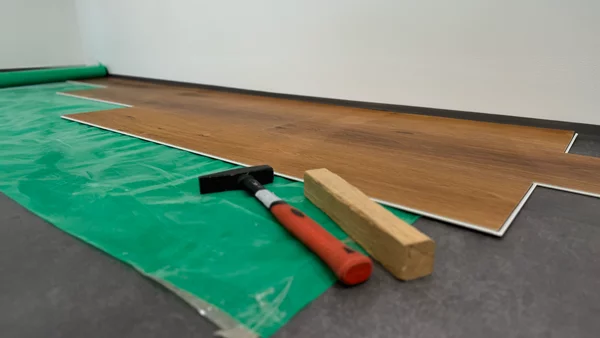

Have you decided to renovate or install a completely new floor, but don’t want to go through the labourious process of removing the old one? Then you might be asking yourself – is there a quicker way? Yes!
There have also been many discussions on this topic across various forums, where you’ll find personal experiences of laying flooring over different materials. Laying a new floor over the existing one can be a quick solution, but this approach isn’t always ideal. And when can you lay a new floor over tiles or an old floor? We’ll explain that in this article.
Did you know that:
incorrect installation will void your warranty?
laying flooring over an existing floor isn’t always suitable?
you must first assess the current condition of your floor (levelness, gaps, etc.)?
every manufacturer requires the subfloor to be level, solid and firm?
if you’re unsure, it’s essential to consult a fitter, who will advise you on the most suitable solution?
When can I lay a new floor over an old one?
So let’s explain when you can lay your new floor over the original floor (linoleum, wooden parquet). This approach is suitable, for example, if your existing floor is in good condition – that is, stable, level, dry and firmly anchored.
The floor must not make any creaking noises. If the requirements set out in the above recommendation are not met, it is not advisable to lay flooring over the existing floor. You’ll only cause yourself unnecessary problems. If you are laying the flooring over tiles, we recommend paying particular attention to the levelness of the surface and the gaps between the tiles, which must be levelled out.
If you have old tiles with pronounced and deep grout lines, we recommend filling them with, for example, CHEMOS OT101 Repair Compound, which has the advantage that the subfloor is ready after just 3 hours. Once filled, you must check the surface for evenness and sand down the filler if necessary. This will ensure a smooth and level base for your new floor. In this case, you can save both time and the cost of removing your old floor.
Whatever the subfloor you are laying on, our recommendation always applies: the subfloor must be solid, stable and level, with unevenness not exceeding 2 mm. Let’s also look at the types of flooring that are suitable for this method of installation, as not all floors are suitable for laying over an existing surface. Ideal candidates are floating floors, such as laminate flooring or composite flooring with a thickness of at least 8 mm.
Take a look at the most popular products suitable for this type of installation – the GERFLOR VIRTUO and PARADOR composite floors.
Conditions you must meet
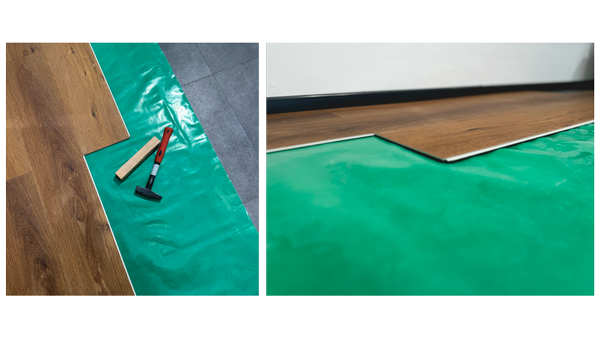
Surface preparation: The existing floor must be clean, dry and level. Any dirt, grease or dust could affect the adhesion of the new flooring. Any unevenness must be levelled out, for example by using a levelling compound. If you are unsure, consult flooring specialists in your area.
Use of underlay: It is advisable to use underlay between the existing and new flooring to improve the acoustic properties of the floor and even out minor unevenness. A correctly chosen underlay will extend the lifespan of the new flooring. Before purchasing an underlay, however, make sure that the flooring you have chosen does not already have an integrated underlay.
Do you know when it is not possible to lay a new floor over an old one at all?
Poor condition of the original floor: If the old floor is significantly damaged, creaky or has pronounced unevenness, laying a new floor may only exacerbate the problem. The fitter themselves should advise on how to reinforce the original parquet after an inspection.
Unsuitable material of the original floor: If the original floor is made of a material that cannot provide a stable and level subfloor (for example, old carpeted surfaces or damaged PVC flooring), it is better to remove it to avoid incurring unnecessary costs for further refurbishment.
Laying a new floor over an old one can be a quick and effective way to renovate, but it is important to follow certain rules. High-quality preparation of the subfloor and a thorough check of the conditions are key to ensuring the new floor has a long service life.
Despite all our advice, we always recommend seeking guidance from a flooring installation expert, which can save you both time and money. When laying flooring yourself, it is important to bear in mind that the person laying the floor takes on the responsibility of ensuring that it is installed in accordance with the manufacturer’s instructions and recommendations.
Have we helped you? Was our article useful? Share it on your profile – perhaps we can help someone you know too.
 Vážený zákazník (NÁZOV)
 Testovací B2B článok 1