
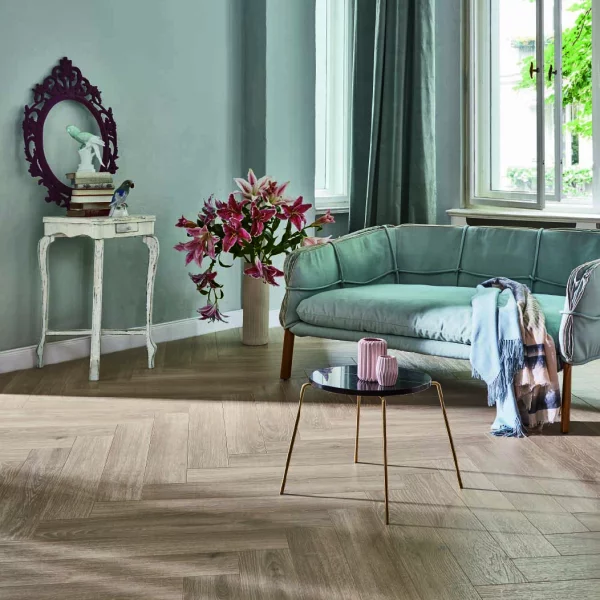






Thanks to its scratch-resistant finish and enhanced resistance to water and spills, laminate flooring is particularly suitable for households with children or pets. However, you can also install wooden flooring using the floating method. With this method, underfloor heating is a very common requirement. But what about laminate flooring?
A common criticism of laminate flooring is that it feels cold compared, for example, to composite flooring. In return, you get a more durable product in your home. What’s more, it’s only natural to wonder whether this drawback could be overcome by installing underfloor heating beneath the laminate. Is this a good idea?

“Be mindful of the heating ramp-up time and the thickness of the floor”
It is possible to combine underfloor heating with laminate flooring, but laminate flooring is not always suitable for underfloor heating. By way of comparison, we have more than 554 floor coverings in our range that are suitable for underfloor heating. Of these, 139 are laminate. You can easily view them using the filter on the left-hand side of the online shop.
And whilst most floor coverings are suitable for use with underfloor heating, there are other materials besides laminate that offer better heat transfer. And better thermal conductivity, which means, above all, faster heat transfer. However, if you’re not planning to buy, for example, composite flooring or vinyl for underfloor heating, then you can also choose from our range of laminate floors.
Take a look at the full range of laminate flooring from PARADOR, with discounts of up to 25 per cent. View the range.
However, their lower price comes at the expense of thermal conductivity. In short, laminate is not the most efficient material for use with underfloor heating. Therefore, when choosing flooring, pay attention to the thermal resistance parameter, which indicates how quickly heat can pass through from the heating system.
When making your calculations, also take into account the underlay and vapour barrier
When calculating and comparing values, however, bear in mind that you may sometimes need to add an underlay beneath the laminate flooring if it is not integrated. And with mineral underlays, you’ll also need a vapour barrier – this has its own thermal resistance, which will ultimately affect the final calculation.
A significant factor that can sometimes cause real problems for a new floor is the maximum surface temperature of the floor. This must not exceed 27°C. Therefore, after installing the underfloor heating and gradually bringing it up to temperature, you must ensure that the temperature does not exceed this limit.
Otherwise, you risk causing irreversible damage to your floating floor. When starting the underfloor heating for the first time, gradually increase the temperature by 5 degrees per day until you reach the ideal setting. Always follow the manufacturer’s instructions in the manual!
In most cases, the maximum temperature you can safely set is 27 degrees. If you have already chosen laminate flooring and wish to install it over underfloor heating, carefully study the flooring manufacturer’s instructions and check with the underfloor heating manufacturer to ensure compatibility with your chosen flooring.
You might be interested in: Which way should you lay a floating floor? The direction of laying can affect more than just the appearance
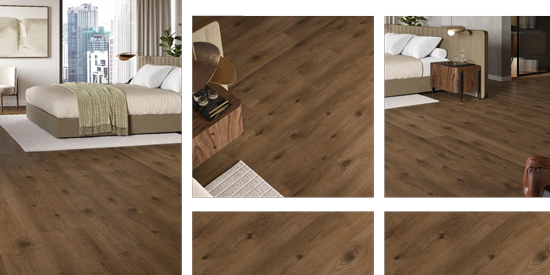
Which laminate flooring should you choose?
There aren’t many manufacturers on our market offering laminate flooring thicker than 18 millimetres. But it is precisely this limit that sets the ceiling for laminate flooring used with underfloor heating. Thicker laminate planks hinder heat transfer. Therefore, to achieve optimal performance, choose laminate flooring no thicker than 18 millimetres.
From our range, we recommend laminate flooring for underfloor heating from the collections of the following manufacturers: Parador, Egger or KronoOriginal.
 Testovací B2B článok 1
  Vážený zákazník (NÁZOV)