





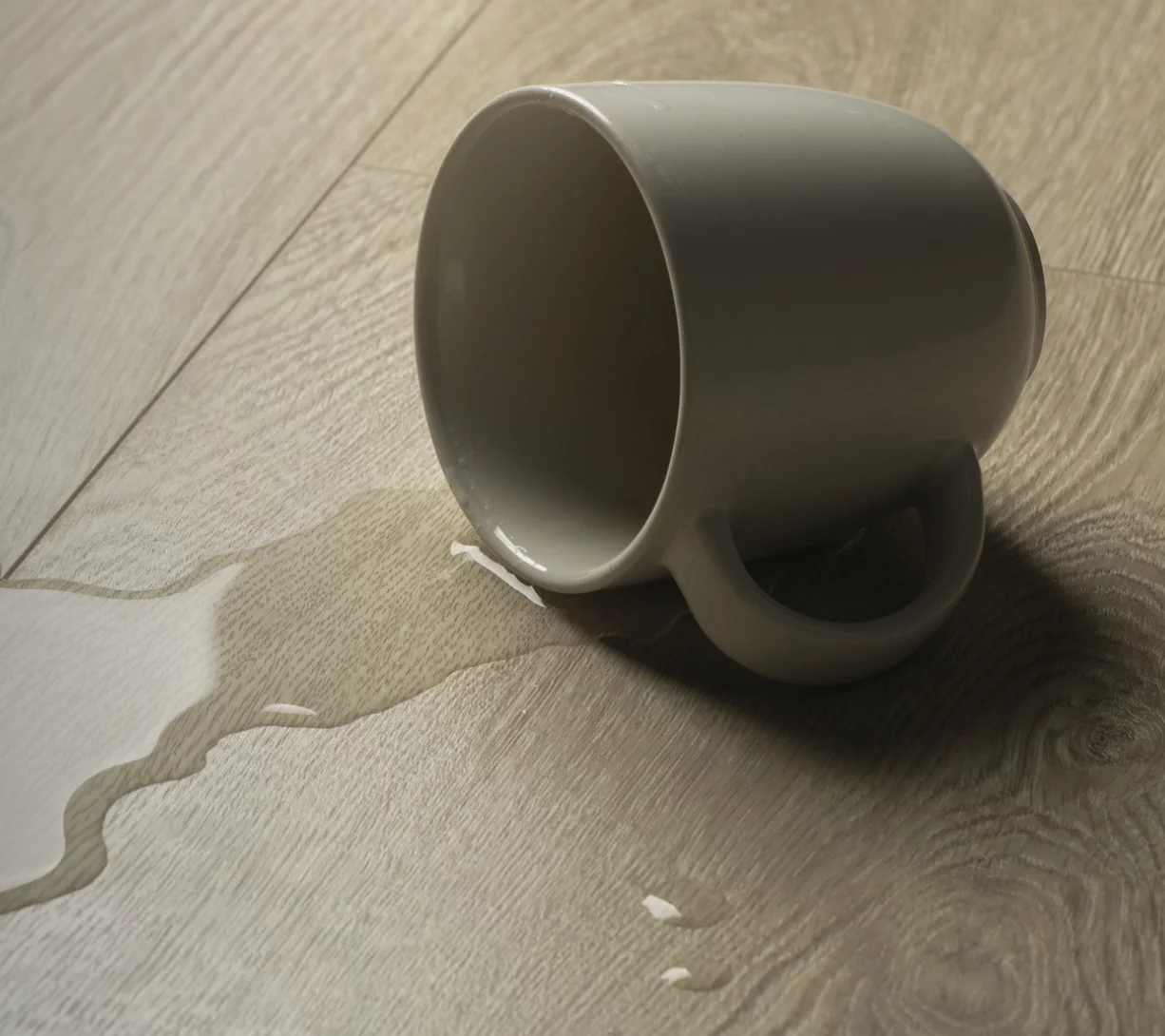
Spilt water on a laminate floor is a common problem, and customers are right to ask what this means for the floor’s durability. Are there other sources of moisture that could damage your brand-new laminate floor?
If you’re wondering how to protect your laminate flooring from moisture, you should be particularly wary of three different sources of moisture. These arise at various stages of the flooring’s installation and use.

Different sources of moisture, different precautions
The first potential source of moisture must be dealt with before the floor is laid – namely, ensuring the subfloor is laid correctly. Do you have a mineral subfloor? If so, you must definitely use a vapour barrier and install it beneath the floor. Otherwise, moisture could rise from the subfloor up to the floor. And this will inevitably ruin it.
What is the second thing to bear in mind? The ambient conditions. Be sure to follow the instructions provided by manufacturers of high-quality flooring, namely the requirement for the flooring to acclimatise on site before installation. With laminate flooring laid as a floating floor, it is essential to allow the material time to adapt to the ambient conditions in which the floor will be laid and subsequently used.
By their very nature – as MDF or HDF core boards – laminate floors are susceptible to changes in temperature and humidity in the environment during installation. If you install the flooring in an unsuitable environment, it is quite possible that a damp environment could cause the laminate material to become saturated. And this will catch up with you later, during use.
What about spilled water on a laminate floor?
The third, most obvious potential source of moisture is water itself during everyday use. Splashes from the washbasin, a spilled plant pot or a leaking washing machine. The most common question is: will a laminate floor be ruined if it gets wet? It isn’t inevitable. By acting quickly and doing your best to minimise the damage, you can save your laminate floor from significant damage.
However, depending on the quality of the flooring and the length of exposure to water, even brief contact can cause permanent damage. The second question is: can a swollen laminate floor be repaired? We’re afraid we can’t give you good news here either – swollen planks won’t return to their original shape. Therefore, the best solution is to replace the planks affected by water.
These cases relate to situations where water has literally seeped into your floor. And your floor isn’t exactly top quality. Some manufacturers offer protection and impregnation for the edges of the planks in such cases, which slows down the process of water penetrating into the core of the floor itself.
How are PARADOR floors tested?
Nowadays, it’s not unusual for high-quality brands such as Parador, Egger Home or KronoOriginal from Germany to offer flooring with water resistance lasting up to 48 hours. This depends on the collection. But this level of water resistance does, after all, give you greater peace of mind and the assurance that, in the event of brief exposure to water or standard cleaning, you need not worry about any significant consequences.
You might be interested in: New: PARADOR launches a laminate floor with enhanced water resistance
Save money up front or think long term?
Saving money isn’t always a good thing. In fact, a more expensive floor from a quality manufacturer at the outset can save you significant costs in the long run. And what if water seeps in through an unprotected and unsealed board? Will mould form under the laminate flooring?
Although it depends on the individual case, in most instances the answer is yes. Mould can form rapidly beneath a laminate floor that has been exposed to water.
If this does happen, it is extremely important to dry the area thoroughly and immediately remove all affected planks. This will prevent mould from forming. Ideally, however, you should bear this in mind when choosing your flooring and look for floors that are certified as water-resistant to a certain standard. How is such a test carried out?

Testing flooring for standing water
As standard, a small, bottomless cylinder is placed on the floor so that it covers the floor joints. Standing water is then poured into it, and it is the effect of this water and the resulting damage that is examined.
Most of the laminate floors in our range meet strict water resistance tests. In the top-of-the-range collections from KronoOriginal, you get resistance to splashing water for up to 48 hours. For example, Parador, a premium German brand, impregnates all its laminate flooring planks as standard, so to speak, ‘right from the start’.
What should you take away from this article? Above all, the realisation that managing and monitoring moisture is essential for ensuring the long-term durability of your new laminate floor. We have outlined three potential sources of moisture that you can eliminate through careful decision-making and the right choice of materials. This includes the flooring itself and the vapour barrier.
Although you can never completely prevent splashed or spilled water, minimising the risk will ensure that your floor remains in excellent condition for years to come.
The best protection against moisture is achieved through a suitable subfloor, professional installation in accordance with the laying instructions, and the use of high-quality laminate flooring certified as water-resistant for a specific number of hours.
 Vážený zákazník (NÁZOV)
 Testovací B2B článok 1